Introduction
Who steps up when tells who leads next. During play between India and Afghanistan, actions depend on hitting sequence, throwing duties, together with where each stands out wide.
Who shows up on each squad matters a lot. These folks take turns batting, bowling, chasing targets. One person might steady the innings when things get shaky. Another could break through with sharp pace at crucial moments. How they link up shapes momentum – some build stands others disrupt them. Overs unfold differently based on who is holding the ball. Runs pile quicker if gaps stay open too long. Match flow twists around these contributions. Each name listed brings something distinct to the field.
Who Matters Most in Cricket
Some people step up when the game gets tough. Others fade back, leaving space for leaders to emerge. Responsibility shifts toward a few during pressure moments. These individuals handle what matters most on the field. Pressure reveals who stays involved when it counts.
They include:
- Opening batters
- Middle order batters
- All-rounders
- Fast bowlers
- Spin bowlers
- Wicketkeeper
Each category affects match flow differently.
India National Cricket Team Key Players
Built on steady hitting plus reliable pace, India’s cricket lineup finds strength in balance. Not just power up front but control at the back shapes their game plan. Where one unit excels, the other follows without lag. Through even contribution rather than standout bursts, they hold their ground. Success comes not from flashes but consistent hand-in-hand effort.
Opening Batters in India Team
First up, the opening batters begin the innings while handling the new ball.
Their role includes:
- Facing first overs
- Building initial partnership
- Reducing early wicket loss
- Setting innings direction
Opening batters influence early score development.
Middle Order Batters in India Team
Middle order batters control the innings after early overs.
Their role includes:
- Through steady play, balance returned when players held firm following dismissals
- Building partnerships
- Managing scoring rate
- Handling spin and pace bowling
Achieving mid-level results shifts how the overall grade looks. What happens halfway through plays a role in shaping the final number.
All Rounders in Indian Cricket Team
Playing with bat, they shift gears – then flip roles to toss the ball underarm or fast. Their hands adapt, moving between crease battles and field sprints.
Their role includes:
- Batting in middle order
- Bowling during middle overs
- Supporting field placements
- Adjusting match balance
Playing both roles lets them shift as needed during games.
Fast Bowlers in India Team
Early on, fast bowlers take the field – then return near the end. Their rhythm fits those moments best.
Their role includes:
- Using new ball movement
- Creating wicket chances
- Bowling in pressure overs
- Supporting field setup
Early on, pace bowling shapes how the game unfolds. Control often leans toward the quicker bowlers right from the start.
Spin Bowlers in India Team
Spin bowlers are used mainly in middle overs.
Their role includes:
- Controlling run rate
- Creating wicket opportunities
- Bowling long spells
- Using pitch variation
Spin plays a major role in Test conditions.
Wicketkeeper in Indian Cricket Team
Behind the stumps, control spreads outward. Position shapes how others stand. One figure directs the flow without moving far.
Responsibilities include:
- Catching behind stumps
- Stumping batters
- Supporting bowling plans
- Communication with captain
Batting sees help too from the wicketkeeper. Sometimes they step up when runs are needed.
Important People in Afghanistan National Cricket Team
Spinning the ball defines how Afghanistan’s cricket side shapes its game plan. Batting deeper into the lineup grows stronger each season. Instead of relying on pace, fingers do most of the work up front. Young hitters get more chances now than before. This balance keeps the team steady through tough matches. Focus stays tight on control rather than speed. Progress shows in longer innings and tighter overs.
Opening Batters in Afghanistan Cricket Team
Frontline hitters take on the first few rounds.
Their role includes:
- Facing a fresh challenge from fast bowlers
- Building opening stand
- Reducing early dismissals
- Setting foundation for innings
Middle Order Batters in Afghanistan Team
Batting next keeps the game moving steady. Then pace shifts as needed through play. After that balance matters most in timing.
Their role includes:
- Recovering after wickets
- Building partnerships
- Supporting run accumulation
- Handling spin bowling pressure
All Rounders in Afghanistan Cricket Team
All-rounders provide balance.
Their role includes:
- Batting support in middle order
- Bowling rotation options
- Field support roles
Spin Bowlers in Afghanistan Team
Spin bowlers are central to Afghanistan bowling plan.
Their role includes:
- Bowling long spells
- Controlling scoring rate
- Creating wicket chances
- Using pitch conditions
Fast bowlers in afghanistan team
Swift pacers back up the fresh-ball rush when they step in. One feeds off another as pressure builds early on.
Their role includes:
- Early overs bowling
- Swing movement use
- Supporting spin attack
- Taking early wickets
Wicketkeeper in Afghanistan Cricket Team
Wicketkeeper supports team structure.
Responsibilities include:
- Stumping and catching
- Field coordination
- Supporting bowlers
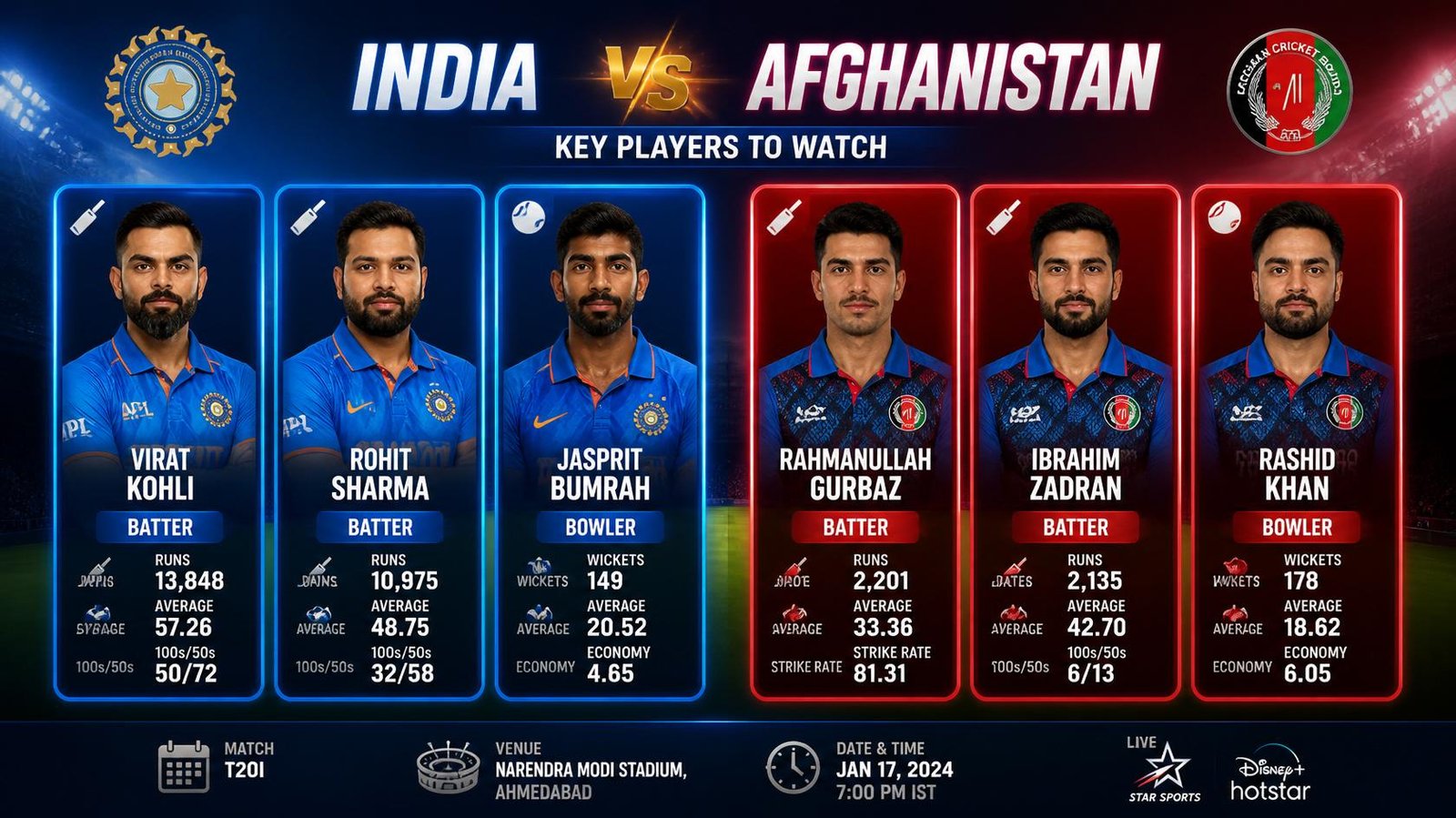
India versus Afghanistan top players compared
When India faces Afghanistan, each standout performer takes on tasks shaped by how their squad is built.
Batting Comparison
India batting structure:
- Stable opening pair
- Strong middle order
- Deep batting lineup
Afghanistan batting structure:
- Developing top order
- Middle order focus on stability
- Lower order support system
Bowling Comparison
India bowling structure:
- Balanced pace and spin
- Rotation system across innings
- Strong wicket-taking options
Afghanistan bowling structure:
- Spin dominant attack
- Longer bowling spells
- Pace used in support role
Fielding Comparison
India fielding system:
- Structured positions
- Strong catching unit
- Quick ground coverage
Afghanistan fielding system:
- Developing coordination
- Improving catching consistency
- Growing field awareness
Key Players and Match Phases
Early overs
- Batsmen step up when the fresh delivery arrives
- Fast bowlers create pressure
Middle overs
- Spin bowlers control game
- Middle order stabilizes innings
Late overs
- Fewer runs come from lower-order contributions
- Bowlers attempt breakthroughs
How Important Players Affect Game Outcomes
Key players affect:
- Run total
- Wicket flow
- Partnership building
- Overs control
- Match direction
Captain and Key Player Work Together
Captain works with key players for:
- Bowling changes
- Field adjustments
- Batting order decisions
How Key Players Shape the Game Plan
India strategy:
- Use batting depth
- Rotate bowlers
- Control sessions
Afghanistan strategy:
- Depend on spin attack
- Build batting partnerships
- Focus on control phases
Conclusion
Out front stands the core of each squad shaping how games unfold – India’s lineup leans on steady bats, while Afghanistan answers with sharp turns in pace. A rhythm builds when one group takes guard, another readies behind the rope. Field spots shift not by habit but who holds the ball at that moment. Even silence between overs tells something about balance tipping back and forth.
From the first few deliveries onward, one performer sets the tone while another takes charge when the game slows down. How things turn out rests entirely on what each person does when it is their moment to step up during different parts of play.