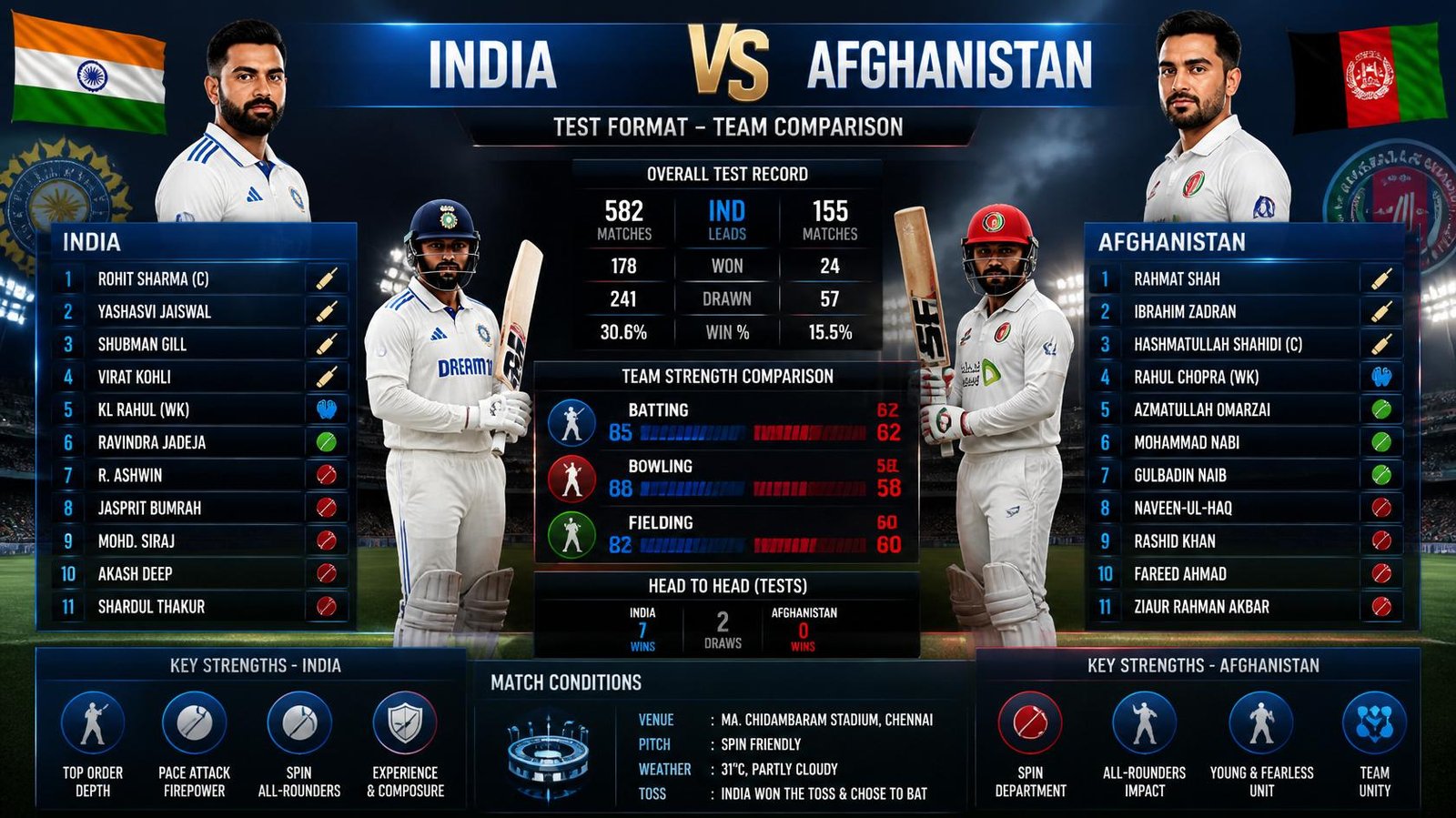
Introduction
Out front, how India stacks up against Afghanistan in Test cricket comes down to more than just names on a sheet. Team makeup shifts the lens – different angles show different strengths. Batting sequences matter, sure, but it is the rhythm between players that shapes outcomes. Instead of relying on one or two big scorers, depth in lineup often tilts balance. Bowling setups? They tell their own story – one built on pace variety or spin patience. Strategy across five days weaves through every session, not just final results. Planning unfolds slowly, like adjusting sails mid-storm.
This piece looks at how Test cricket squads are built, focusing on player jobs within each team. One moment it breaks down the usual eleven who take the field, then shifts to how far down the lineup can bat effectively. Instead of listing things plainly, it weaves through how bowlers are chosen depending on conditions. Field placements emerge later, shaped by intent rather than habit. Approaches to winning unfold without mention of clichéd strategies. Roles matter more than names here, showing balance over individual fame.
Team Comparison Meaning in Test Cricket
Looking at teams in Test cricket means checking how one matches up against another through various measures
- Batting order structure
- Bowling attack system
- Fielding performance
- Match planning
- Session control
How a group functions depends on who is picked and what situation they face. Some adapt fast when roles shift unexpectedly. Others stick close to old routines under pressure. The mix of people changes how tasks unfold every time.
Test Cricket Format Overview
Test cricket is played over five days.
Structure includes:
- Each side takes their turn twice at bat
- Each inning allows as many overs as needed
- Three sessions per day
- Outcome decided by how many runs plus the number of wickets lost
Later moments shape what happens when batsmen fall. How many runs pile up matters just as much as overs passing by. Wickets lost shift everything slowly, then all at once.
India Test Team Setup
India national cricket team follows a structured Test setup.
Batting structure
Batting lineup is divided into:
- Openers who face new ball
- Middle order batters who control innings
- Last of the lineup contributing late runs
Each batting position has defined role in innings flow.
Bowling structure
Bowling unit includes:
- Fast bowlers for new ball overs
- Spin bowlers for middle overs
- Mixed attack for final overs
Depending on how the surface plays, bowlers come in different orders. Match phase also shapes who bowls when.
All-round structure
All-round players support:
- Batting depth
- Bowling flexibility
- Field balance
Wicketkeeping role
Wicketkeeper supports:
- Catching behind wicket
- Stumping actions
- Field coordination
Afghanistan Test Cricket Team Setup
Afghanistan’s national cricket side shows progress in building its presence within Test matches. Though new to the longer format, steady steps mark their path forward. Each game adds experience, shaping how they compete at this level. Growth comes slowly, yet signs point toward deeper involvement ahead.
Batting structure
Batting order includes:
- Openers for new ball survival
- Middle order for stability
- Lower order for support runs
Focus remains on building long innings.
Bowling structure
Bowling unit includes:
- Spin bowlers for control overs
- Fast bowlers for early overs
- Support bowlers for rotation
Spin plays major role in match control.
All-round structure
All-round players support:
- Batting flexibility
- Bowling coverage
- Field support
Wicketkeeping role
Wicketkeeper supports:
- Catching and stumpings
- Communication with bowlers
Batting Comparison India versus Afghanistan
India batting structure:
- Stable top order
- Strong middle order
- Depth in lower order
Afghanistan batting structure:
- Developing top order
- Middle order building phase
- Backbone of basic help structure
Staying steady matters most for India. For Afghanistan, learning through doing shapes their path forward.
Bowling Comparison India versus Afghanistan
India bowling structure:
- Pace bowlers for new ball
- Spin bowlers for middle overs
- Rotation system for control
Afghanistan bowling structure:
- Spin dominant attack
- Developing pace attack
- Longer bowling spells by spinners
Off the mark, India leans on a mix of batters who share the load. Meanwhile, spin shapes almost every move Afghanistan makes.
Fielding Comparison
India fielding structure:
- Strong catching unit
- Structured field positions
- Quick ground fielding
Afghanistan fielding structure:
- Improving field system
- Developing catching consistency
- Growing coordination
How a team catches the ball shapes how many runs are scored plus affects wicket counts on either side.
Batting Order Comparison
India batting order:
- Structured opening pair
- Controlled middle order
- Finishers in lower order
Afghanistan batting order:
- Developing opening pair
- Middle order stability focus
- Lower order support role
How a team builds its lineup shapes how it handles the innings. The way batters are placed can shift who stays in charge during play.
Bowling Rotation Comparison
India bowling rotation:
- New ball pace attack
- Spin in middle overs
- Flexible rotation system
Afghanistan bowling rotation:
- Spin based long spells
- Pace used in short bursts
- Less rotation depth
How Test Cricket Strategies Differ
India strategy:
- Build innings slowly
- Use spin in home conditions
- Control sessions
Afghanistan strategy:
- Survive early overs
- Build partnerships
- Use spin control in middle phase
Session Control Comparison
Morning session:
India focuses on wicket control
Afghanistan focuses on survival
Afternoon session:
India builds pressure
Afghanistan builds partnerships
Evening session:
India uses bowling variation
Afghanistan tries stability
Pitch Adaptation Comparison
Dry pitch:
India uses spin attack
Afghanistan depends on spin survival
Green pitch:
India uses pace support
Afghanistan adjusts batting approach
Flat pitch:
Both teams focus on batting control
Experience Comparison
India experience level:
- High international exposure
- Strong Test match history
- Stable player pool
Afghanistan experience level:
- Limited Test exposure
- Developing player base
- Growing match experience
Captaincy and Leadership Compared
India leadership:
- Tactical field changes
- Bowling rotation control
- Batting order adjustment
Afghanistan leadership:
- Developing strategy system
- Field adjustment learning
- Match situation handling
Squad Depth Comparison
India squad depth:
- Multiple batting options
- Multiple bowling options
- Strong bench strength
Afghanistan squad depth:
- Limited but developing options
- Spin heavy backup system
- Emerging players
Match Situation Handling
Batting situation:
India stabilizes innings
Afghanistan focuses on survival
Bowling situation:
India applies pressure
Afghanistan seeks breakthroughs
Balanced situation:
Both teams adjust strategy
Player Role Comparison
India players:
- Defined batting roles
- Specialized bowling roles
- Strong field structure
Afghanistan players:
- Flexible roles
- Spin focused bowlers
- Developing batting roles
Performance Pattern Comparison
India pattern:
- Stable scoring
- Controlled wickets
- Session dominance
Afghanistan pattern:
- Gradual scoring
- Wicket survival focus
- Learning-based performance
Match Outcome Factors
Result depends on:
- Batting stability
- Bowling control
- Fielding performance
- Session dominance
- Pitch condition
Conclusion
When you look at how India and Afghanistan line up in Test matches, their setups feel different. Experience leans toward one side, shaping how each plays. The batting sequence isn’t built the same way across both teams. One relies more on spin, while the other mixes pace with variation. Game plans shift based on these contrasts.
Nowhere near identical, India leans on seasoned players supported by deep reserves. Meanwhile, Afghanistan builds slowly, banking heavily on spinners while stretching toward longer games. How they play Tests could not be more distinct – each shaped by separate paths and priorities.